Back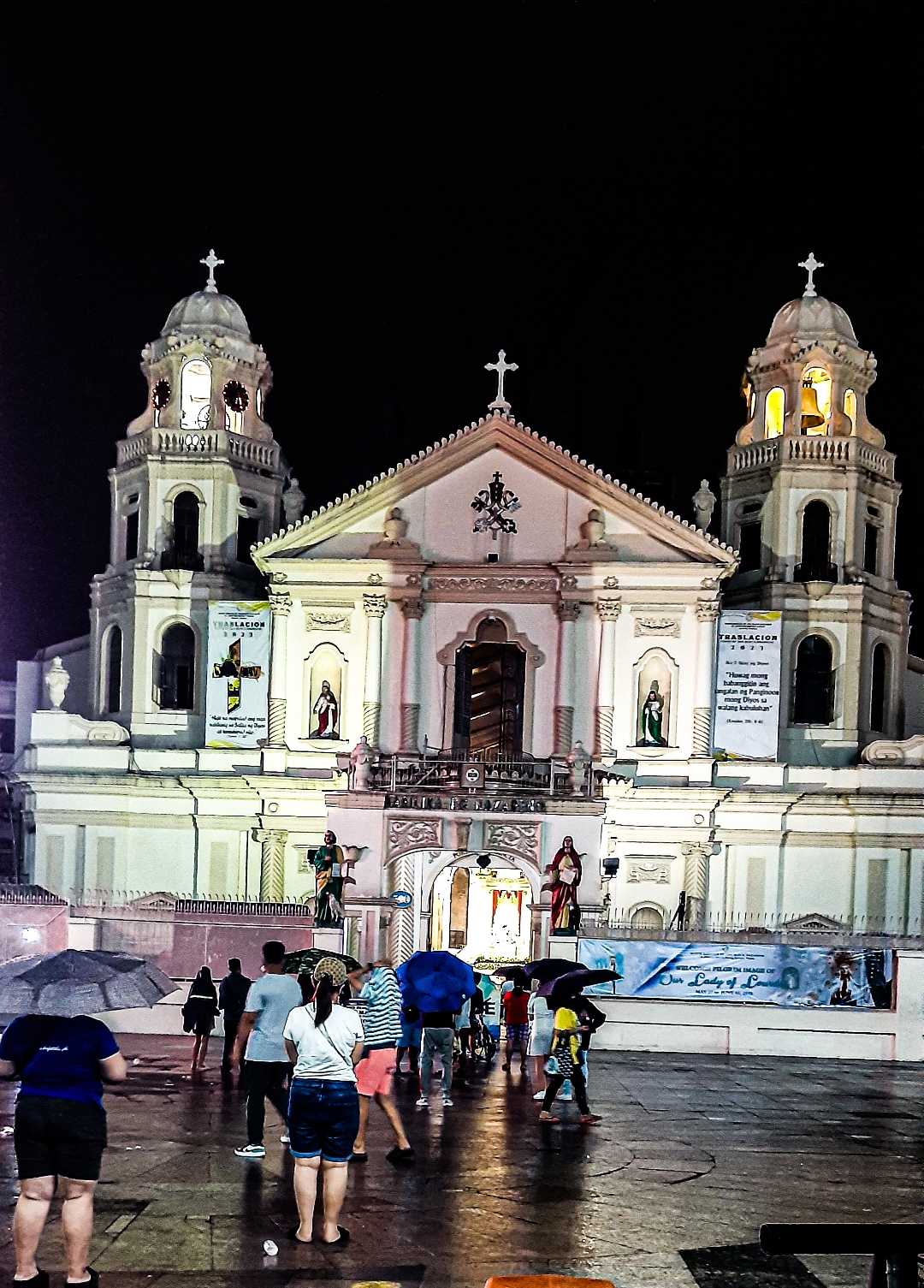





May 21, 2023
The Minor Basilica of the Black Nazarene
📍Quezon City
The Minor Basilica of the Black Nazarene, known canonically as the Saint John the Baptist Parish, and colloquially as Quiapo Church, is a prominent basilica in the district of Quiapo in the city of Manila, Philippines. The basilica is famous since it is the home of the Black Nazarene, a dark statue of Jesus Christ said to be miraculous. The basilica is under the jurisdiction of the Archdiocese of Manila.
The earliest church, built by missionaries of the Order of Friars Minor, was made of bamboo for the frame and nipa leaves as thatching. In 1574, Limahong and his soldiers destroyed and burned the church. Formerly a visita (chapel-of-ease) of Santa Ana, the Franciscan friar Antonio de Nombella founded the church in 1588 which was dedicated to Saint John the Baptist, the forerunner of Christ. It burned down in 1603 and the parish was temporarily turned over to the Jesuits until secular clergy objected. Governor-General Santiago de Vera initiated the full construction of the church in 1686. On April 8, 1639, the administration of the church was returned to the seculars who had always taking care of the church's welfare.
During the Seven Years' War, the British attempted to destroy the church in 1762 as they invaded Manila. An earthquake in 1863 destroyed the church and in its place a temporary church was built. Fr. Eusebio de León later reconstructed the ruined church in 1879, completing the structure in 1889 with the assistance of Rev. Manuel Roxas. Roxas had raised the unprecedented amount of ₱40,000.00 from donations and lay contributions. In 1929, the church caught fire again, in which the church's wooden ceiling and sacristy were destroyed.
Present church
In 1933, Fr. Magdaleno Castillo began the reconstruction of the church from the plan prepared by National Artist of the Philippines architect Juan Nakpil – son of composer Julio Nakpil. He added the church's dome and a second belfry to balance out the façade. The reconstructed church, made of reinforced concrete, was completed in 1935. During World War II, parts of Quiapo were destroyed except for Quiapo Church.
Msgr. José Abriol appointed architect José María Zaragoza and engineer Eduardo Santiago to expand the church in order to accommodate more devotees. The church was expanded from 1984 to 1986. Changes to the building were made, such as the removal of the ornate exposed trusses, the removal of the interior columns to create an expansive columnless structure, and the realignment of the perimeter walls. Even though Zaragoza did not tamper the facade and altar area, his renovation project received criticisms like comparing the new interior with a basketball court. The criticisms did not affect the popularity of the church.
Jaime Cardinal Sin, then-Archbishop of Manila, reconsecrated the church on September 28, 1987. On December 11 of the same year, Pope John Paul II issued papal bull Qui Loco Petri, elevating the church as a minor basilica. It was solemnly declared a basilica on February 1, 1988, by Papal Nuncio to the Philippines, Archbishop Bruno Torpigliani, who also blessed the altar of Saint Lorenzo Ruíz on that day.
In 2006, the church celebrated the quadricentennial anniversary of the arrival of the image of the Black Nazarene in the Philippines. As part of the celebrations, a jubilee wall was set up at the entrance gate where devotees would post and write their personal testimonials on their faith and devotion to the Black Nazarene.
_WIKIPEDIA
#PindlePhilippines
#Quiapo church Manila Philippines
💬 6 comments
Comments (6)
AndrotimosMay 21, 2023
nice shot coach 😍👏
KarishmaSinghMay 21, 2023
nyc
HERMANDHESMay 21, 2023
wow 😳😳
Benson Tolarba Cariñaga May 21, 2023
😮😮😮