Back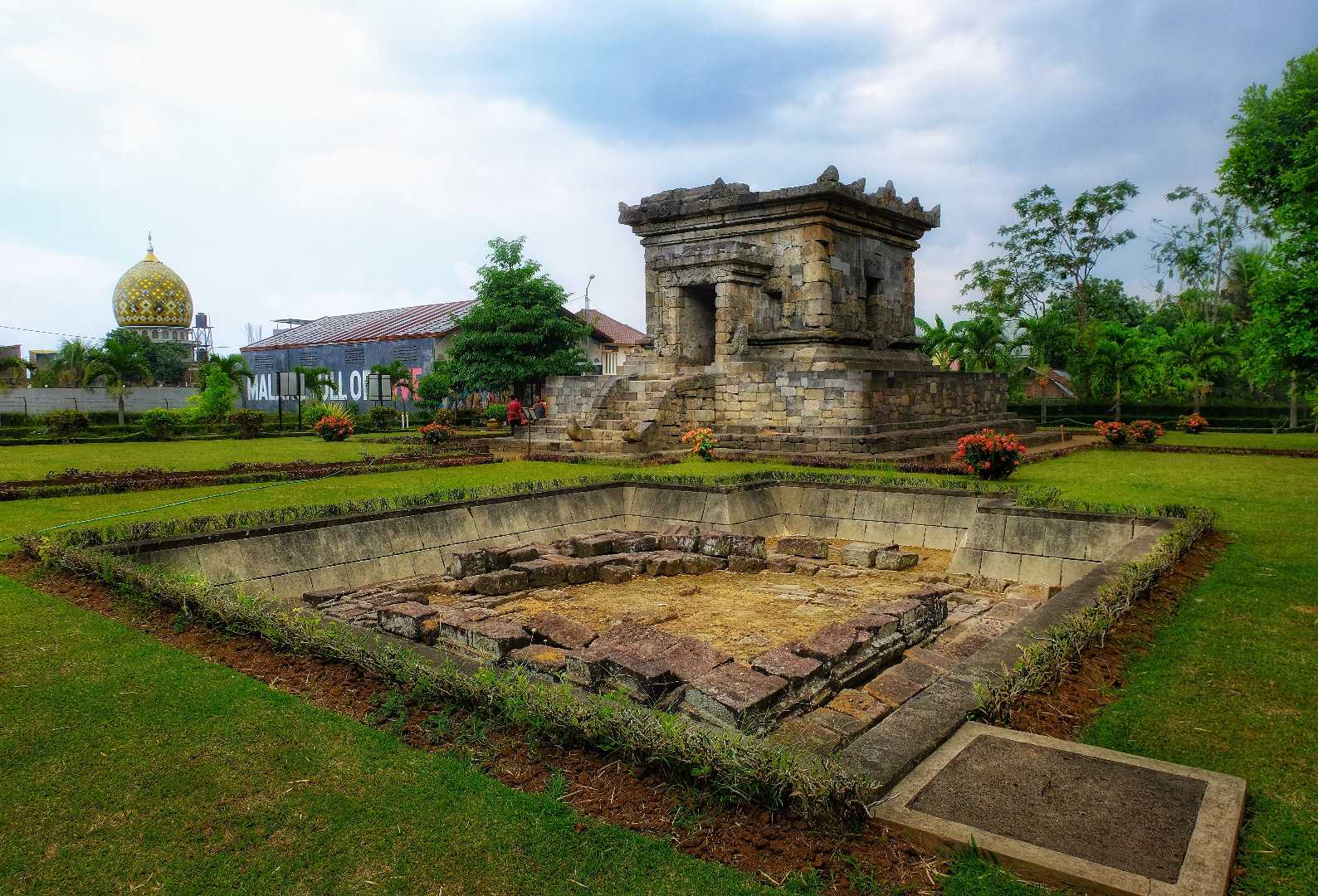




October 17, 2021
the Badut Temple
📍Kecamatan Sukun
HEAR the word clown, surely what comes to mind is an entertainer who polished his face with thick powder and dressed strangely, and was fluent in making funny faces.
Unlike this one clown, the Clown temple. The name of a temple in Karangbesuki District, Malang Municipality. The word clown itself comes from the Sanskrit "Bha-dyut" which means the highlight of the Canopus Star or the highlight of Agastya.
This can be seen in the main room of the temple which contains a pair of unreal statues of Shiva and Parvati in the form of a phallus and yoni. On the outer wall there are niches containing the statues of Mahakal and Nadiswara.
In the northern recess there is a statue of Durga Mahesasuramardhini. The eastern recess contains a statue of Ganesha. To the south there is a statue of Agastya i.e. Shiva as Mahaguru. But among all the statues, only the statue of Durga Mahesasuramardhini is left.
Judging from its shape, the Badut temple is similar to the temples in Central Java from the 8th to the 10th centuries, especially in the Dieng highlands such as the Gedongsongo Temple. The temple material is made of andesite stone. The temple's feet are plain unadorned. The entrance is given a viewer. The kalamakara that decorates the top of the door does not use the lower jaw.
The Badut Temple was once surrounded by a wall which is now gone. Some of the temple ruins are still visible scattered here and there which of course is a certain part of the temple which until now has not been able to ascertain what form it came from.
A staircase flanked by the cheeks of the stairs is decorated with carvings of kinarakinari (heaven creatures with the body of a bird with a human head who are in charge of playing heavenly music). The decorative fields beside the temple niches are decorated with floral patterns. The roof collapsed. In front of the entrance there is a pedestal of three smaller perwara temples. In the courtyard of the temple to the north and south there are two cube-shaped stones with a rectangular hole.
This temple was discovered in 1921 where its shape at that time was only a mound of rock, ruins, and soil. The first person to report the existence of the Badut temple was Maureen Brecher, a Dutch controller who worked in Malang.
Badut Temple was rebuilt in 1925-1927 under the supervision of B De Haan from the Antiquities Bureau of the Dutch East Indies. From the results of excavations carried out at that time it was known that the temple building had completely collapsed, except for the legs which could still be seen in their composition.
The surrounding stones are then selected and collected according to their type and size. On this basis then tried to arrange the building. In 1926 the entire structure of the legs and body could be rebuilt, except for the roof which could not be recovered.
In 1990-1993, the Clown Temple was restored by the Regional Office of the Ministry of Education and Culture and the East Java Historical and Archaeological Heritage Sanctuary, through the Project for Preservation/Utilization of East Java Historical and Archaeological Heritage, which was carried out in stages.
Efforts to preserve and foster Cultural Conservation Objects are intended so that our cultural heritage remains sustainable which can show our identity as a cultured nation.
#guidebook
💬 8 comments
Comments (8)
monica selfianiOctober 17, 2021
kerennn
Phunsukh_WangduOctober 19, 2021
beautiful , thanks for details🙏
Dhana_DeeOctober 28, 2021
Luar biasa storynya