Back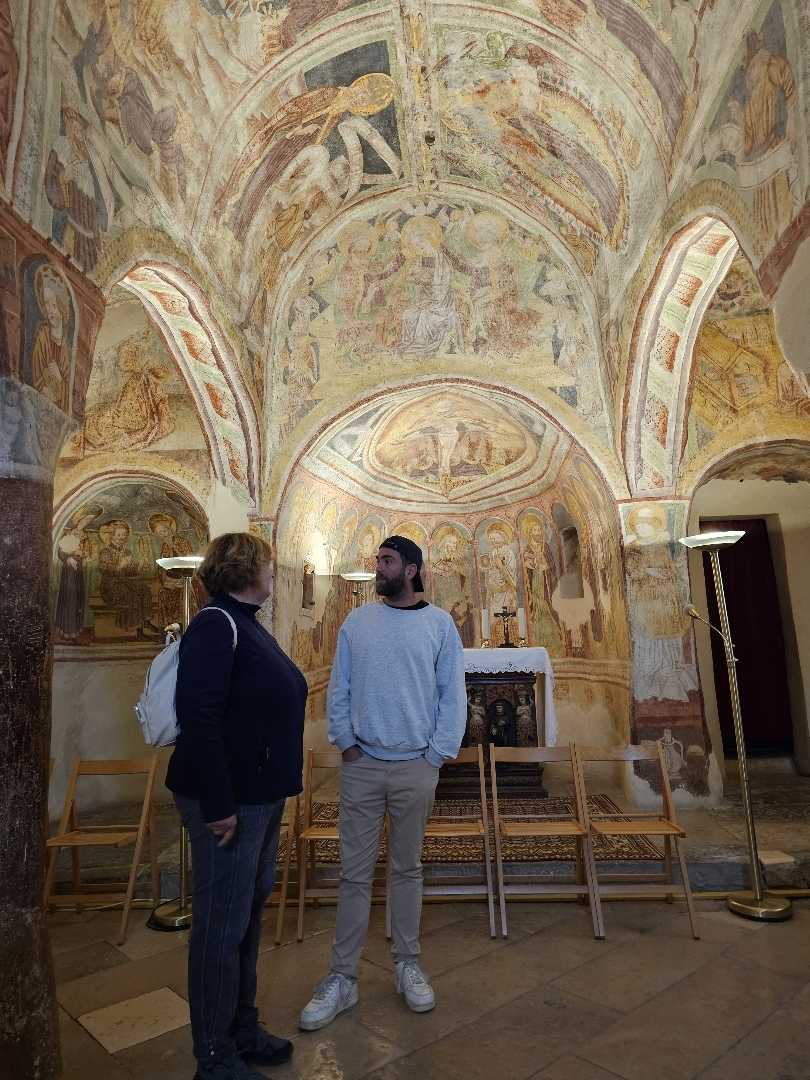
September 17, 2025
Cerkev in Hrastovlje
📍Koper
In Novel
It was a scene of people of all classes, from beggars to kings, dancing with skeletons, and heading to their deaths. Daebak stood before the painting and pondered,
"Does this mean no one is exempt from death...?"
The expressions of the figures in the painting, dancing with skeletons and heading to their deaths, were grotesque yet somehow resigned. The painting seemed to convey a religious message. Daebak carefully observed the painting from the beginning of the wall, muttering to himself,
"Skeletons are leading humans to death. At the very end is the judge. Lena, have you seen this painting?"
My idea
The mural in this novel, depicting people dancing with skeletons and heading to their deaths, functions as a complex symbol, alluding to the nature of this world and the fate of human existence. While the skeletons appear comical on the surface, dancing with people and heading somewhere, it holds profound philosophical and religious meanings. This scene evokes the iconographic tradition of the "Danse Macabre" or "Dance of Death," a frequent occurrence in medieval Europe. This, in turn, evokes the medieval philosophy of "Memento Mori" (Remember Death). Based on the idea that all humans are equal in the face of death, the image of skeletons dancing with humans, laughing, does not evoke fear, but rather a powerful question: "How should we live?" The procession, seemingly heading toward the final destination of the afterlife, highlights Daebak's existential position between life and death, visually suggesting why he awoke in this world. The figure of the "Judge" appearing at the end of the mural is not a terrifying guardian of the apocalypse. He is a symbol of divine power, a judge who judges all of humanity from beyond the boundary between life and death and a symbol of the decision Daebak faces. The expressions of the humans dancing with the skeletons are also noteworthy. They are not simply terrified, but rather the faces of those who have embraced something. In other words, it captures the resignation and compliance of those who sense their own end. This image also connects to the theme of the conflict between free will and fate, demonstrating the irony of fate: if you don't choose your own path, you will inevitably follow someone else's. Daebak-i refuses to submit to such fate but instead chooses his own sword and stands as a subject who carries out his will. Furthermore, this painting functions as a kind of prophetic device. It is not a historical record containing memories of the past but a composition that symbolically foretells future events. The skeleton dance procession in the painting is not simply a celebration of death, but suggests a coming catastrophe, a spiritual rift, and a clash between light and darkness, implicitly imprinting Daebak-i, the chosen one, at the center of all these currents. Ultimately, this mural is a device like a blueprint for the world, condensing the four keywords of death, judgment, fate, and salvation. Gods, giants, spirits, and the twelve priests—the central axis of the entire spiritual order—are subtly presented in this painting, and it is also the reason Daebak must awaken the "light" dormant within himself and embark on his journey. This mural is not mere decoration; it is a prophetic symbolism that hints at death, judgment, and Daebak's mission as the chosen one. It is the key to the future hidden within the spiritual blueprint of this world.
💬 4 comments
Comments (4)
DaebakSeptember 17, 2025
Thank you so much ❤️ Irma
HERMANDHESSeptember 17, 2025
the best moments brother 👍💪